
Dynamic Symmetry
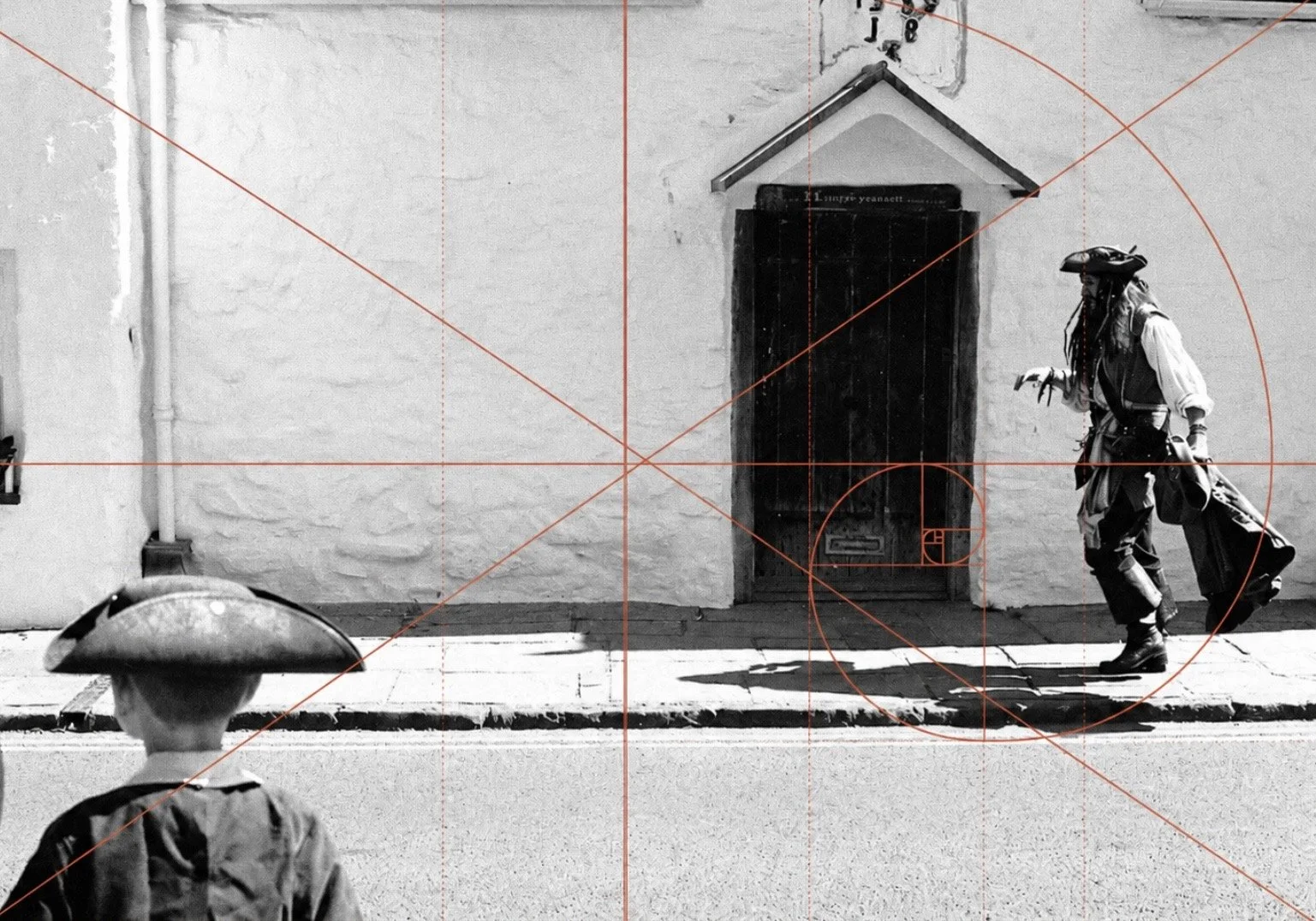
It should come as no surprise that Henri Cartier-Bresson remains one of my greatest heroes. His work left a permanent mark on photography, and it could easily be argued that he was the first true master of the 35mm medium. What has always fascinated me about Bresson is that he studied painters rather than photographers. Geometry mattered deeply to him, perhaps even more than light itself and composition was never accidental.
Over the years I have spent time studying painters, trying to understand why certain compositions feel balanced, alive, or emotionally complete. One principle that has stayed with me is dynamic symmetry. It is something I continually try to absorb into my photographic psyche; to instinctively overlay onto a scene before the shutter is released rather than analysing it afterwards.
The image in question was taken on a pre-focused Nikon F3 with a 50mm f/2 lens at 500/f8, and was built around the tension between the two figures, the child in the foreground and the pirate crossing the far pavement. Nothing here was staged, the scene was entirely observational, captured in a fleeting moment.
The negative space was essential to the composition. Some will say I should have cropped tighter, but for me the emptiness of the wall gives the pirate room to enter the frame. That space amplifies both the sense of isolation and the slight theatricality of the scene.
Movement was equally important especiallyy capturing those Jack Sparrow moves. The pirate’s stride follows the dominant diagonal of the composition, while the shadow beneath reinforces the sense of motion. When I later overlaid a dynamic symmetry grid onto the image, it was satisfying to see how naturally the figure fell into one of the dynamic power areas. None of this was consciously calculated in the moment, but I believe years of studying composition help train the eye instinctively.
I also wanted a clear separation between foreground and background planes. The out-of-focus child acts as an anchor in the foreground while the pirate occupies the active space beyond. That layering was intended to create depth within what is otherwise quite a flat architectural scene. The gap between them is made of two lanes, compressed by the 50mm perspective.
I di not shy away from hard contrast. I feel the harsh sunlight works here because the scene itself is graphically simple. The dark doorway becomes almost a visual void an anchor point within the composition.
When I made the photograph, it was ultimately a combination of eye, geometry, and lots of luck!
Although the dynamic symmetry overlay is interesting, I do not believe the spiral is the strongest compositional relationship in the image. For me, the true structure is triangular, the relationship between the child’s hat, the doorway, and the pirate. That triangular tension keeps the eye circulating naturally around the frame.
The placement of the pirate on the right-hand side is also important. He is walking into visual space rather than out of it, giving the frame energy and continuation. Timing mattered enormously too as the entire image depended on capturing the precise position of the feet, hands, and stride at exactly the right moment. The pirate had mimicked Jack Sparrows walk all the way down the street, I had already decided that this was a key element to the image.
I believe images like this are only possible because of Bressons teachings, added to the rolls and rolls of wasted film trying! I still consider myself very much a student, but I feel incredibly fortunate to have access to the work of the masters, both painters and photographers alike.